Weigh It, Sniff It, Steam It: A Winter Forage Audit for Riding School Yards
Every yard has a horse who coughs twice at the tie-up rail and then trots off sound and cheerful. Most of the time it is nothing. Occasionally it is the first line of a story that ends with a vet bill, a course of steroids and a box rest you did not plan for.
Winter forage is where that story usually starts. Bales get bought in bulk, stored wherever there is space, and fed by the slice because nobody has time to weigh anything at six in the morning in the dark. None of that is unreasonable — but a small amount of structure around forage is the cheapest respiratory insurance a yard can buy.
The tie-up rail is your early warning system
Horses tell you about dust before they tell you about anything else. A dry cough in the first few minutes of work, a nasal discharge that appears after hay and clears during turnout, or a horse who seems to have a 'cold' every winter but never in summer — all worth writing down rather than shrugging off.
The clinical term to know is equine asthma, which covers what older books called RAO, COPD or simply 'heaves'. Mild cases are extremely common in UK stables and are managed, not cured. Management starts with what goes in the haynet.
Audit one: weight before volume
Slices are not a unit of measurement. A slice from the middle of a tight bale can weigh nearly twice what a flake off the end does, and the horse notices the difference even when the human does not.
The routine that works on a busy yard is dull and takes about ten minutes a day once it is set up:
- Hang a luggage scale on a beam in the feed room. Cheap ones are fine.
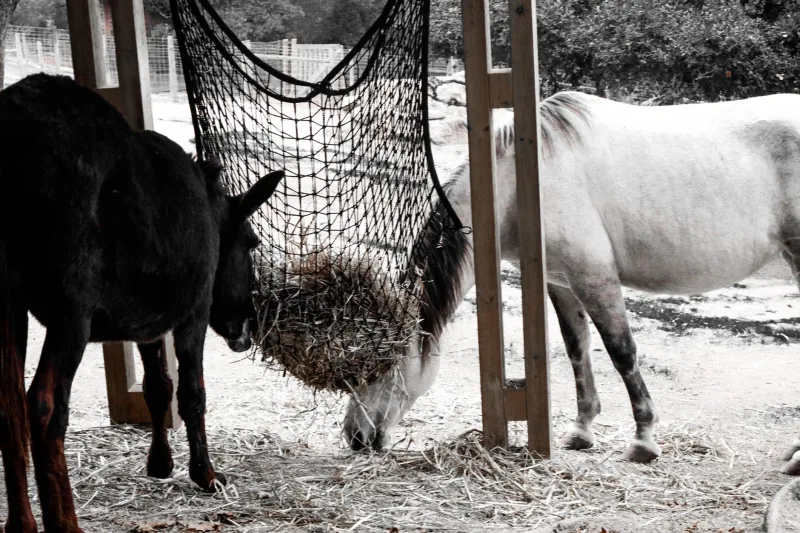
- Weigh three nets at the start of the week — small, medium and large — and label the nets with the weight rather than the horse's name.
- Feed by weight, aiming for a minimum of around 1.5% of bodyweight in forage dry matter per day, with ad-lib access wherever the horse's waistline allows it.
- For a 500kg horse that is a floor of roughly 7.5kg of dry forage a day, more in hard weather. In deep cold snaps, most horses do better with more, not less.
- Recheck any horse that drops condition or gains it, because winter rugs hide a lot.
If a yard is feeding 'a slice twice a day' and nobody has ever weighed it, that is the first thing to fix. It is also, quietly, one of the biggest cost savings available — overfeeding forage by a couple of kilos a head per day across twelve horses is a serious amount of money by March.
Audit two: the sniff and shake test
You do not need a laboratory to spot questionable hay. You need a torch and a bit of honesty.
Shake a slice out over a clean wheelbarrow in decent light. Look for the visible puff that hangs in the air, black or white patches, a musty or sour smell, or the sweetish, sharp odour that suggests heating. Check for rodent droppings, bat droppings, and the fine grey dust that settles at the bottom of the bale.
A bale that makes you cough is a bale worth rejecting. If you would not want to breathe it for eight hours, a horse with a 60-litre pair of lungs certainly should not.
Matching the bale to the horse
Hay and haylage are not interchangeable, and the difference matters more in a school than in a private yard.
Hay is drier, generally lower in sugar and digestible energy per kilo, and easier to ration for the good-doer. It is also the dustier option unless handled well.
Haylage carries more moisture, usually more energy, and far less dust. It suits poor-doers, veterans and horses with sensitive airways. But it demands discipline: wrapped bales must be intact, opened bales need using within a few days in mild weather, and damaged wrap raises the risk of botulism, which is not a risk worth taking to save a tenner.
On a mixed yard the sensible arrangement is usually two forage streams rather than one compromise. It costs a little more in logistics and saves a great deal in vet fees.
Soak, steam, or leave it alone
Soaking works. A 20–30 minute soak in warm water, or several hours in cold, will reduce respirable dust substantially and leach some water-soluble sugar. The practical catches are the ones that get skipped: change the water between nets, drain properly, and do not leave soaked hay sitting around in a mild December — it heats fast and gets less appealing by the hour. Soak water should go on the muck heap or the garden, not down the drain.
Steaming is the tidier option for a busy yard. Commercial steamers run 50–60 minutes and deal with dust and spores without the drippy nets and freezing taps. Most horses eat steamed hay readily, which is more than can be said for a badly soaked net on a frosty morning.
Leave it alone if the forage is genuinely clean, well stored and the horse has no history of cough. Not every yard needs a steamer. Plenty need a better hay supplier.
Storage: the bits everyone forgets
- Never store hay above or directly beside stabled horses. The dust falls through the floorboards, and the horses below get the worst of it.
- Stack on pallets, off the floor, with airflow behind and a gap at the eaves.
- Keep the oldest bales at the front and actually use them first.
- Open haylage bales away from the stable block and clear up loose wrap.
- Check the roof. A single leak over a stack will spoil the bales underneath before anyone notices.
The weekly forage checklist
Ten minutes, once a week, written down so it actually happens:
- Weigh two random nets per forage stream and record the figures.
- Shake out a slice from an opened bale and inspect under a torch.
- Smell each opened bale. If it is off, say so and pull it.
- Check wrap integrity on all haylage bales in the stack.
- Note any horse with a cough, discharge or increased breathing effort at rest.
- Confirm soak and steam equipment is clean and working.
- Log the supplier batch and date so a problem can be traced later.
When to stop managing and call the vet
A cough that persists beyond a couple of weeks, breathing that looks laboured at rest, flared nostrils at the stable door, or a horse who stops finishing their forage all warrant a conversation with your vet rather than another change of hay. Forage management is the foundation, not the whole treatment plan.
The unglamorous truth is that winter respiratory trouble is mostly prevented by boring habits: weighed nets, clean bales, dry stacks and someone bothering to look. None of it is difficult. All of it is easier in October than in February.