Rug Rules, Not Rug Guesswork: A Winter Blanketing Protocol for Riding Schools
Every yard has one. The rider who arrives on a cold morning, gives a horse a sympathetic look, and quietly adds another rug. By the end of November the poor animal is wearing more layers than the yard manager and steaming gently by ten o'clock.
Rugging isn't a personality test, and on a riding school it certainly isn't a solo decision. With twenty or thirty horses on the books, three staff sharing the morning yard, and a client base stretching from a nervous nine-year-old to a retired farmer who 'knows horses', the space between good intentions and a consistent policy is exactly where trouble lives.
Here's a straightforward way to close that space.
School horses are the hardest horses to rug for
A competition horse has one job and one rider. A school horse has six riders before lunch, three of them gripping, two of them freezing, and one who is quietly having the best lesson of their life. That horse will be warm from work, cool down while standing in a queue for the arena, then go out at noon and stand in a wet wind for five hours.
That's a completely different rugging problem from the one most online guides are written for. It needs a system, not a feeling.
Start with an audit, not a rug
Before you discuss grams and fills, know what you actually own. A rug audit takes one wet afternoon and saves an entire winter of guesswork.
- List every horse by name, with age, condition score, workload and clip.
- List every rug: type, fill, size, waterproofing status, repair history.
- Bin or bag anything with a failed surcingle, a broken leg strap or a ripped shoulder. February is a terrible time to discover a leak.
- Match rugs to horses, not the other way round. Two 6'3" turnouts between eight horses is a fact worth knowing in October.
- Photograph the finished chart. It will get lost. It always gets lost.
Then write the thing everyone actually needs: a single laminated sheet in the tack room saying which rug goes on which horse in which weather.
The bands: a starting point, not a gospel
Any yard chart has to begin somewhere. Use something like this, then adjust for the individual horse in front of you — the thin seventeen-year-old and the woolly native do not belong in the same row.
| Conditions | Unclipped | Trace or blanket clip | Full clip |
|---|---|---|---|
| Mild, 10°C+, dry | No rug | No-fill sheet or 0–100g | 100g |
| Cool, 4–9°C, dry | No rug if well-conditioned and in work; 100g if thin or older | 100g | 200g |
| Cold, 0–3°C, dry | 100g, or none on a hardy good-doer | 200g | 200–300g |
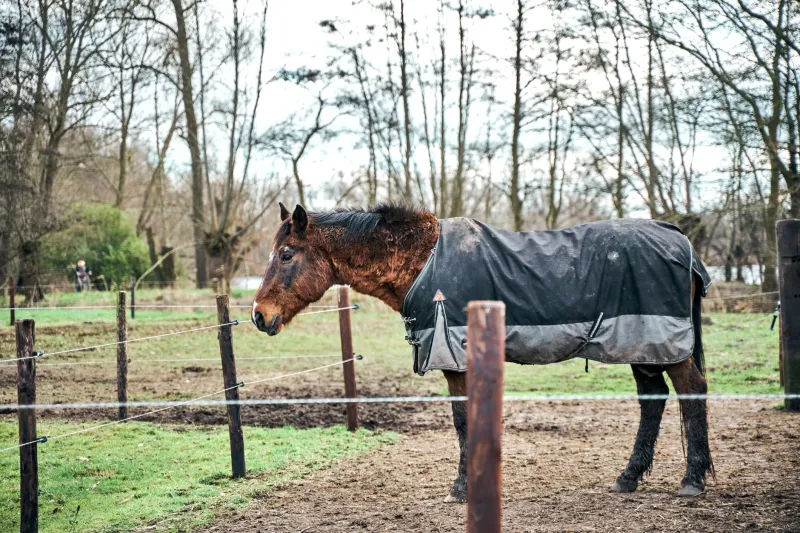
| Wet and windy at any temperature | Add 100g or switch to a waterproof no-fill | As above, plus waterproofing | As above |
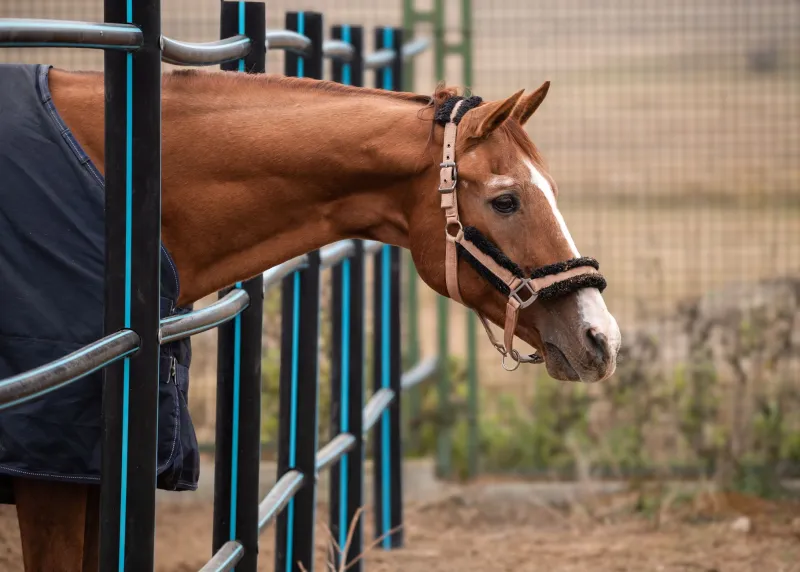
Two rules sit above the table. First, wet plus wind beats cold on its own almost every time, so a waterproof no-fill often does more useful work than a heavier rug that soaks through. Second, check the horse rather than the weather app — feel under the rug at the shoulder and hindquarters, and look for a tucked-up belly or a sweated-up neck.
Clipping is a decision, not a default
A school horse in full work and growing a yak coat will sweat through a lesson and stand around damp afterwards, which is worse than being a bit chilly. But a full clip commits you to rugging decisions every single day for four months.
Most yards land somewhere sensible: trace or blanket clips on the hardest-working horses, nothing on the light workers, and a rule that no horse is fully clipped unless someone has agreed who manages that horse's rugs on weekends, bank holidays and the days the yard is shut.
Turnout versus stable should not be a personality trait
If one member of staff rugs for turnout and another rugs for standing in, you don't have a policy — you have a coin toss. Pick one approach and hold it. Many yards now run school horses unrugged or lightly rugged through the day and slightly warmer overnight, which suits horses that work in the morning and stand in from four.
The important thing is that seven o'clock looks the same on a Tuesday as it does on a Saturday, whoever is holding the headcollar.
Write it where people actually look
The best rug chart in Britain is useless in a filing cabinet. Put it in three places: laminated in the tack room, pinned in the yard WhatsApp group, and on a whiteboard by the gate. Update it when a horse is clipped, changes condition, or goes on box rest. Say out loud at the morning meeting that the chart has changed.
The client conversation
Parents and part-livery clients will rug your horses for you if you let them. Give them something better than a vague reassurance. A short, friendly line works wonders: 'Arnie is on a 100g turnout today — he runs warm and he's working twice, so we check him at lunchtime. If you're ever worried, message the office rather than adding a rug, and we'll go and feel him.'
That single sentence prevents most of the over-rugging on a busy yard, because it gives people a route for their concern that isn't a fifth layer.
The handover test
On a wet Wednesday in January, stop any member of staff and ask what Arnie is wearing today. If you get two different answers from two different people, your protocol isn't working yet — and it's the chart that needs fixing, not the horse.
Rugging well isn't about being right every time. It's about being consistent, written down, and honest enough to change when a horse tells you that you've got it wrong.