The Arena Breathes Too: A Fifteen-Minute Winter Air Walk for Riding Schools
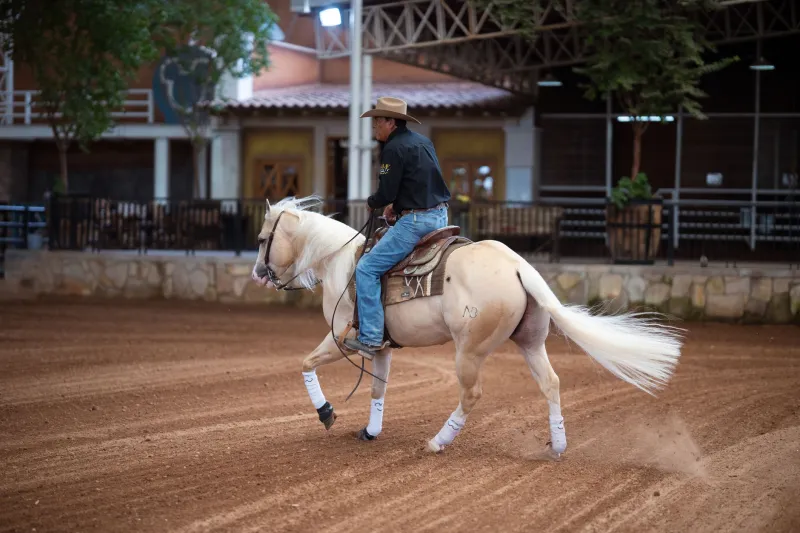
There is a particular sound an indoor school makes in winter. Hooves, a bit of snorting, the occasional clang of a pole — and then, somewhere on the centre line, a cough. One cough is not a crisis. A chorus of them, week after week, is the arena telling you something.
When the big doors stay shut against the weather, dust, ammonia and stale air have nowhere to go. That does not mean every indoor school is a problem. It does mean winter is the season to pay attention. A fifteen-minute walk round the arena and stables, done properly, can catch the obvious issues before they turn into a yard-wide cough.
This is not a substitute for your vet. It is a look, a listen and a list of jobs.
Start by standing still
Before you check a single vent, stand in the middle of the arena for two minutes. Do nothing. Breathe normally. Look up at the roof and along the walls. Listen to the horses working.
Ask yourself a few plain questions. Does the air feel heavy or sharp? Can you smell ammonia, or is there a dry, dusty edge to it? Are the windows steamed up? Is there a haze in the light from the roof panels? Do horses cough at rest, on the first trot, or only after canter?
Those two minutes are often more useful than a clipboard. If the arena smells like a deep bed that has not been mucked out properly, that is information. If your eyes feel gritty before you have done anything, that is information too.
Walk the walls and look up
Take a slow lap of the arena perimeter. You are looking for airflow, not just open windows. High-level vents, roof lights, sliding panels and ridge openings all matter. So do the things that block them: cobwebs, hay dust, bird nests, stored poles, old banners and Christmas decorations that never quite came down.
Check that vents actually open. A vent that has been painted shut is not a vent. Check that doors are not being kept closed all day simply because the yard is tidy. In cold weather, the temptation is to seal the place up like a flask. Horses still need fresh air moving through.
Look at the surface too. Is it being watered or maintained in a way that creates dust when ridden? Are there dry patches near the doors that puff up every time a horse passes? A dusty arena surface is not automatically dangerous, but it adds to the load on every horse breathing in that space.
Check the stable block with your nose
Ammonia is the smell most yards know and most yards ignore. A faint whiff at the door is one thing. A sharp sting at the back of your throat when you open a stable is another. It usually means urine is sitting in the bedding, the drain is not doing its job, or the stable is not being fully mucked out often enough.
Walk the block at horse height, not people height. Crouch a little. Open the top door and let your nose tell you what the horse is living in. Check bedding depth and condition. Is the bed wet underneath? Is the straw dusty? Are rubber mats lifting and trapping wet? Is there condensation running down the walls?
While you are there, look at the hay. Shake out a slice and hold it up to the light. Does it make you cough? Does it smell musty or sweet? Is it dusty enough to leave a cloud in the aisle? Soaking or steaming hay can make a real difference for a sensitive horse, but it is not a fix for a whole yard with poor ventilation.
Test the airflow, not just the temperature
A warm arena is not necessarily a well-ventilated one. Stand at one end and watch the dust motes in a shaft of light. Are they drifting, or hanging still? Hold a light piece of tissue or baler twine near a vent and see if it moves. Open a door at each end of the building for a few minutes and notice whether the air changes.
You are not trying to create a wind tunnel. You are trying to avoid a sealed box. In practice, that often means opening high vents, clearing blocked openings and making sure doors are not shut all day out of habit. Small changes, done consistently, beat a dramatic blast of cold air once a week.
Know when it is a vet job
A cough in a school horse is not automatically a ventilation problem, and a ventilation problem is not automatically the whole story. Ring your vet if a horse has a persistent cough, nasal discharge, laboured breathing, flared nostrils, a raised temperature, reduced appetite or a cough that gets worse with exercise. A horse that is dull, off its feed or breathing hard at rest needs professional advice promptly.
Also take note of patterns. Does the same horse cough every time it enters the indoor? Does it settle once outside? Is the cough worse after hay is put out? Is it only the horses stabled near the muck heap? Write it down. Your vet will thank you, and so will your yard manager.
The fifteen-minute routine
Two minutes standing still. Five minutes walking the arena walls and checking vents, doors and surface dust. Five minutes in the stable block, checking bedding, hay and ammonia. Three minutes noting what you found and who is going to fix it.
That is it. No specialist kit, no drama. Just a proper look at the air your horses are breathing when the doors are shut. If the centre line has started to sound like a chest clinic, do the walk before you book another lesson. The arena has been trying to tell you something since the first cold snap.