Before the Leg Goes On: Six Arena Exercises That Build a Calmer Canter Departure
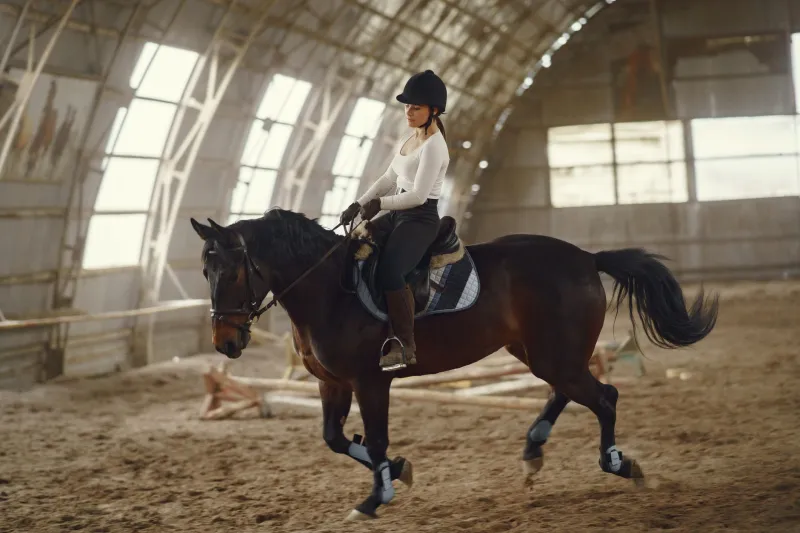
Canter is a three-beat gait, not a finishing move. Yet in plenty of winter lessons it gets asked for like a sprint finish: rider kicks, horse scrambles, head comes up, and the last three strides feel suspiciously like a gallop.
Instructors know the pattern well. A school horse learns to anticipate the request, adds a bit of speed to be helpful, and inside a fortnight every departure has become a small panic. The answer is almost never more leg. It is teaching the transition itself — the balance before it, the timing of it, and the patience around it.
Why the rush creeps in
Three usual suspects, in our experience.
Anticipation. A horse who has cantered on the same diagonal four times in a lesson knows exactly what is coming. They offer speed before you ask. Speed is not impulsion, and the horse cannot tell the difference unless someone teaches them.
Rider nerves. A worried rider sits forward, grips with the knee and swings the leg back. The horse reads that combination as go faster now and obliges. The rider then feels the surge, brakes, and the whole thing repeats next circuit.
Winter arenas. Small, busy, and often carrying a bit of depth after a wet week. There is less room to ride forward into balance, so the ask comes early, out of a trot that was never really there. A trot without balance will not produce a canter with any.
Six exercises that teach the transition
1. The walk check. Ask for canter only from a walk that is marching, not shuffling. Ride a 20-metre circle, ask at the same marker every time, and accept a calm strike-off as the win. If the walk was poor, the canter will be worse — so treat fixing the walk as the exercise itself.
2. Three honest strides. In working trot, ride three deliberate strides with a half-halt on the third, then ask. Three strides is long enough for the rider to feel the difference between pushing and preparing, and short enough to keep a novice's attention.
3. The pole gate. Place a single pole on the circle. Trot over it, then ask for canter two strides later, at the same spot each time. The pole does the gymnastic work; the rider only has to keep the rhythm and stay out of the way.
4. Downward first. Spend an entire lesson on canter-to-trot transitions before touching an upward. Pick a letter, count the strides, ride the downward from seat and leg rather than hand. Horses who know a calm downward start offering a calmer upward almost unprompted.
5. The lunge slot. For the rider who cannot yet sit quietly, ten minutes on the lunge with no reins and no steering achieves more than twenty rushed circles on their own. It is also a genuinely useful option when the school is full of December liveries and there is nowhere to go.
6. Count it out loud. Ask the rider to count the rhythm in trot, then in canter. If the numbers speed up the moment the leg goes on, you have your diagnosis in about eight seconds. It also gives a nervous rider something to do with their brain.
What instructors actually see when it goes wrong
Watch the first three strides and you will usually spot one of these:
- Rider folds forward as the leg goes on, tipping the horse onto the forehand.
- Inside leg swings back rather than staying at the girth.
- Hands creep forward, dropping the contact at the exact moment the horse needs it.
- The ask is repeated three times in a row, so the horse learns that the first request is optional.
- Rider sits too light in the saddle, then grips with the knee to compensate — which blocks the shoulder and produces a hurried, flat canter.
None of these are confidence problems. They are habit problems, and habits respond well to short, repeated, boring exercises. Boring is the point.
A 20-minute winter lesson plan
Built for six riders in a 20x40, under floodlights, with a horse each and no spare time. Adjust the numbers, keep the order.
- 0–3 minutes: Walk on both reins, no stirrups for the last circuit if the group is up to it. Check girths and that everyone can halt straight.
- 3–7 minutes: Transitions within walk and trot, every long side. Focus on the rider staying still and breathing out before the upward.
- 7–11 minutes: Exercise 2, three honest strides, split across both reins. Walk breaks are allowed and encouraged.
- 11–15 minutes: Exercise 3, the pole gate, on the better rein first. One canter departure each, then rotate so nobody is queuing behind a nervous rider.
- 15–18 minutes: Canter departures on the second rein, three per rider maximum. If a horse scrambles, come back to trot, rebalance, ask again from a better place rather than pushing through.
- 18–20 minutes: Walk on a long rein, stretch, and give one piece of homework each. For most of the group it should be the same piece: ride the walk before you ride the canter.
Change the words, change the result
Language shapes what a rider does with their body. 'More leg' tends to produce a kick. 'Ask, then wait' tends to produce a pause, and a pause is where balance lives. Try 'set the trot up, then offer the canter' or 'sit still and let the horse come to you' — both are far more useful than a shouted 'kick on' at C.
It is also worth remembering that a school horse does this for a living. They are asked for canter perhaps twenty times a week by twenty different pairs of hands. Consistency of the ask matters more than the strength of it, and a horse who trusts that the request will be quiet is a horse who stops running into the transition.
The takeaway is simple enough to write on the arena whiteboard: canter is a balance, not a speed. Teach the balance and the speed takes care of itself.